Showing posts with label Bangladesh. Show all posts
Showing posts with label Bangladesh. Show all posts
Thursday, 15 September 2016


Thursday, 9 June 2016
10,000 Views
My not-so-popular ‘Blazon’ has finally moved into five viewing figures and it is time to evaluate the situation.
Starting from the beginning of time, politics seems to dominate, although not deliberately, and the most popular Post dealt with using a percentage to develop fair salaries (Percentage Formula - August, 2013). I have temporarily removed this article in an attempt to allow other articles to surface into view. This places Travel 5 - South East Asia (Bangladesh) of August, 2012, into a more suitable position.
Statistics
Google Chrome has been, by far, the most popular Browser at 40% overall the whole period and, today, increasing to 81% for the month.
Microsoft Windows OS, originally, had a slight lead over Apple Macintosh OS by 47% and 36% respectively, but this lead has been definitely eroded over the years to 22% (Windows) and 67% (Macintosh).
Naturally, Canada and the USA have produced predominant viewers with Russia following closely (My personal letter to Mr. Putin may have had an affect. Ha!). Interestingly, many other countries have shown interest, notably; China (of course). Australia, Netherlands, Germany, Poland, Brazil, and Sweden (Surprisingly, countries in the Middle East were not represented).
It is hard to imagine six viewing figures, therefore a change of direction may be required (To quote Lao-tse) but that is probably in another life.
Sunday, 1 November 2015
Education 11 - Qualifications
I have been commenting on Google+ with someone who was advised that using the title Photojournalist was illegal because she did not have any academic qualifications related to such occupation (Even though she was, obviously, highly skilled). I wrote that this was only a term and, therefore, the question was simply grammatical. Only by registering a business name, e.g., Photojournalist Limited could it attain any form of legality.
Others joined the conversation to point out that the use of the term doctor was also illegal. I replied that the word doctor was also just a term unless used in conjunction with an academically related descriptor such as Doctor of Medicine ... naturally from a recognized university. Otherwise, the term doctor could be used if there is no academic representation, e.g., PfD. (Doctor of Feng Shui) or PcD. (Doctor of Chocolate) and such use would suffer a certain, deserved, humour. This applies, equally, when using the term accountant or engineer without a degree. Graduate accountants should become members of professional institutes and, thus, become accredited Chartered Accountants (CA), and engineers would become Chartered Engineers, etc., and the list goes on.
Therefore, if ever someone shouts, “Is there a doctor in the house?” Please be aware of the real need.
At one time, I was employed privately in a contract position in Bangladesh as a teacher of EFL at a corrupt private teaching hospital that should remain nameless (International Medical College). An American university also had a contract to, among other things, provide academic faculty. Thus, they hired an itinerate American individual who was idling in Asia as a teacher without any formal EFL qualification (Undisclosed B.A.) and permitted him to use the title, Professor (Not even Associate Professor) for influence purposes, while I was addressed as Mister, even though I had worthier experience and skills but, unfortunately, without any association with the said university. Incidentally, the other teacher had never even stepped within the walls the university. When last heard of, he was studying by Internet with an Indian university, while resident in the Philippines, for a combined, one-year, MA/PhD. degree, that simply required the review of a number of obscure novels ... you may try to figure that out on your own.
In contrast, I know of great numbers of university teachers with credible PhD. degrees who are only Assistant or Associate Professors. This is solely the prerogative of the university ... and acceptable to most of us.
Now, I must conclude this, perhaps, nugatory post to concentrate on my overdue Culture of Chocolate thesis.
By the way, if there seems to be a sense of victimization within this post, it is intentional ... and would deserve comment.
Saturday, 12 October 2013
A Bangladesh Sweatshop
I read this article (Actually, it is more than just an article, it is an stunning essay), such that it brought back emotional feelings to me following my own tour to Bangladesh. I hope that everyone finds time to read it.
I Got Hired at a Bangladesh Sweatshop.
Meet My 9-year-old Boss
Meem, 9, works 12-hour shifts at a factory in Dhaka, Bangladesh. She dreams of becoming a sewing operator, buying more hair clips and helping her family.
Toronto Star reporter Raveena Aulakh works undercover in a Bangladesh garment factory for a first hand look at their working conditions.
DHAKA, BANGLADESH—Some days are good for Meem, others she likes to forget as quickly as possible.
The first time I saw Meem, which was also my first day at work at a sweatshop, she was having a good day despite the wretched heat. She sat cross-legged on the concrete floor, a tiny, frail figure among piles of collars, cuffs and other parts of unstitched shirts.
She had a pair of cutters in her hands, much like eyebrow tweezers, and she was trimming threads from a navy collar. She cleared one collar after another of threads until the big pile, which had been bigger than her, was no more. It took her all morning and she didn’t look up much, did not join any conversation. When it was done, she took a few gulps of water from a scrunched bottle, walked around for a bit, her little hands rubbing her back, and went back to trimming threads — this time, from navy cuffs.
She did that from 9 a.m. to 9 p.m., except for an hourlong lunch break. Later, she said, it had been a good day: the electricity didn’t play hooky (which meant the three ceiling fans worked all day) and so it wasn’t oppressively hot, she had fish curry for lunch, and the floor manager didn’t yell at her for humming too loudly. It was a very good day, she said again, dancing a little jig.
Meem is 9 years old and works as a sewing helper in a garment factory. For a few days this summer, she was also my boss.
She taught me the tricks of trimming. She taught me to smile when my back ached. She taught me some Bengali words.
Sab bhalo. It is all okay.
Getting the job
On a sweaty day this August, I arrived at a factory in a neighbourhood near Lalmatia in southwest Dhaka. The wide streets were lined with old buildings and were clogged with rickshaws, crowded buses and fancy cars. Clothes were hung out to dry from balconies, restaurants shared common front yards with abattoirs. At most street corners, there were shoe-shine men, tiny places that served tea and Bengali sweets.
Bangladesh: Survivors of the Rana Plaza collapse
Morning time was almost always more chaotic as schoolchildren in uniforms scrambled to get to class and grown-ups hurried to work.
Off a main street and at the end of a laneway was the sweatshop.
Hamid, formerly a sewing operator with a big garment factory in Narayanganj, is the owner. About three years ago, he took a loan and started his own business — a small factory that operates without a name — and today employs about 45 people.
I walked in the first morning just after 8, a bottle of water in hand, and introduced myself to Ali, the floor manager, as Rubina, the new sewing helper. He is a small, wiry man who, I later discovered, cooks and sleeps at the factory. He nodded and told me to take a look around.
Getting the job hadn’t been easy. Before Rana Plaza collapsed in a Dhaka suburb on April 24 and 1,129 people lost their lives, reporters got into factories and chronicled the appalling safety conditions, child labour and subsistence salaries. Now big factories have security and careful screening. Outsiders, especially non-Bengali speakers, are looked at with deep suspicion. Even though my appearance helped, it didn’t help that I don’t know Bengali and don’t look impoverished. Initially, I tried to get a job at a big factory with the help of some well-connected friends in Dhaka. But as a friend said, his factory owner friend simply asked him why he didn’t just give me — the down-on-her-luck relative — money.
In the end, a cabbie I had hired while on assignment in Dhaka last year came through. A friend of his friend owned a small factory making garments for local retailers and often taking orders from big factories when they faced deadline pressures.
The cabbie told Hamid that his wife’s cousin (me) was an Indian woman who had recently moved to Dhaka, knew a few words of Bengali and needed a new start.
Hamid was in a bind. Some of his workers hadn’t returned from their villages after Eid and he had a deadline to meet. So he said yes, he would try me out for a few days. If I did well, we would talk money, said Hamid.
The factory wasn’t big: about two dozen sewing machines lined the walls of the windowless room, about half the size of a basketball court. Two cutting machines sat in a corner. The sewing machines had little benches for the operators, and almost all had piles of colourful fabric by the side. Three ceiling fans, covered with layers of dirt, hummed quietly.
In one corner was Hamid’s office. It had glass windows and a glass door. Most fabric was kept there before it was cut. A phone sat on the desk with an old computer that was almost never used.
There were no fire extinguishers, no exit other than the main door (I later counted another 21 sewing machines on the second floor of the same building. A rickety staircase was the only way up. Workers on the main and second floor didn’t socialize much).
The sole washroom was right at the end of the laneway, opposite the sweatshop. It was dimly lit, with puddles of dirty water, and the toilet was little more than a hole in the ground. It was used by every business on the floor; even for showering by those who live there, including Ali, whose clothes hung on a clothesline in the narrow hallway. Rats frequently visited.
At the factory, the sewing helpers, seven of us, always sat in the middle of the floor, trimming threads, ironing, folding and later packaging.
That first day, in the centre of the floor, sat Meem.
Her father, who worked at another garment factory, had an early shift and so he had dropped Meem off. Even though work didn’t start until 9, she was already trimming threads. Ali gestured for me to sit on the floor and in rapid Bengali told Meem to give me work.
As soon as his back turned, Meem, who was nibbling on a samosa, told me to take it easy.
“It is your first day . . . just watch for a couple of hours,” she said shyly. She was easy to love.
No one at the factory, including Meem, knew I was a reporter. Except for a few questions about her family, I never interviewed her: everything in the story is what I saw, what I heard.
I watched her and I watched Ali and began to understand how the factory worked.
Ali preferred to cut fabric into shirt pieces himself and did so every morning before the workers arrived. He then distributed the pieces, along with matching thread, to sewing operators. Some stitched shirt arms, others collars, cuffs and pockets.
The week I was there, the sweatshop had an order for men’s linen shirts. No one knew how many exactly or where the shirts were heading. The way each shirt was sewn, at least in that factory, was astounding for the number of steps each takes, the details and the tasks, the repetition and the relentlessness. Like most people, I had never thought of it before.
The fabric for the shirt body was cut into three panels — the back, left side front and right side front. The sleeves, cuffs, pockets, pocket flaps and collars were cut separately. One woman would feed fabric into a machine and hundreds of collars would come out strung together by thread. A helper would then separate them and trim any dangling threads.
One sewing operator focused on finishing cuffs; another stitched together collars; another sewed cuffs or collars to the shirt panels. Pocket flaps and pockets were sewn separately and then attached.
That is how every part of the shirt was made — sewn on its own and then stitched together. Every part of the shirt went separately through the helpers who trimmed the threads. Once assembled, the shirt returned to the floor so any threads could be trimmed before it was ironed and packaged.
I thought trimming sounded easy and it was, except I hadn’t counted on the hours spent sitting on the concrete floor without a backrest and the cutter digging into my thumb and forefinger.
It was back-breaking, it was finger-numbing. It was particularly rage-inducing. Not because it was painfully hard work but because children like Meem hunched over hour after hour, squinted at the threads, cleaned one collar after another, one cuff after another, one arm piece after another until the piles were depleted.
Then other piles arrived — some larger than the previous ones but almost always larger than Meem.
Nipping a hole while trimming was a terrible sin. It happened a couple of times a day.
Ali, who stood by the entrance watching, eventually noticed it and screamed at everyone until whoever was responsible owned up and then a sewing operator would try to salvage the piece, grumbling loudly.
There was a lot of yelling, mostly by Ali. It wasn’t clear how many shirts workers were expected to sew in an hour or a day but it was expected that they stay hunched over their sewing machines every minute they were at the factory. Snack breaks had to be quick, bathroom breaks even quicker.
Meem, the youngest, was often yelled at because she chatted too much and twice because she was humming a Bengali song too loudly.
Meem and the sewing helpers were paid the least, earning about $26 Canadian a month if they worked from 9 to 5 every day or about $32 if they worked overtime and stayed until 9 p.m. Most did. There were no weekends, except for a half-day every Friday, no sick leave, no holidays. If a worker took a day off, it came off the paycheque.
Still, in a country where so many live in grinding poverty, Meem’s was a prized job, even though the minimum wage at this factory was between $30 and $38 a month.
“When I become a sewing operator, I will make very good shirts,” Meem promised. “No one will yell at me.”
That’s how big she dreamed: to graduate to a sewing operator one day.
School’s out
How Meem left school and started working at the factory is a fairly common story among poor Bangladeshi families: too many mouths to feed, too few bringing in money.
A few months ago, Meem’s mother, who worked as a domestic helper in Dhanmondi, an affluent Dhaka neighbourhood, found out she was pregnant and unable to work. Around the same time, Meem’s brother, a 15-year-old construction worker, argued with his parents about how much money he should contribute to the household. He left to live on his own.
With Meem, her three little sisters and a baby on the way, Meem’s father took her to Hamid and asked if she could work there. Hamid said yes and just like that, school was out, 12-hour work shifts were in.
It is not as if Meem’s parents don’t care for her — they simply had no choice. Meem said her father did not want her to work at just any factory but chose Hamid’s because her aunt works as a sewing operator and would keep an eye out for her.
Meem’s wages go directly to her father. She is allowed to buy hair clips — she loves glitter — once a month, and an occasional ice cream. “I have 11 hair clips,” she said one day, holding up both her hands and spreading her fingers. “So many.”
Meem’s friend at the sweatshop was Taaniya, a 13-year-old with long, dark hair and a shy smile. The older girl, always wearing the traditional salwar kameez, a long shirt with pants and a long scarf, taught Meem little tricks: for instance, how to hold the cutter close to the edge to get the best results but not nip the cloth. Or how to fold a shirt and then iron it, saving time.
Taaniya, who has been working for a few years, also told Meem which sewing operators complain the most and should be avoided.
Lootfah, 15, a pretty, fair-skinned operator, was their favourite. She was kind, happy and didn’t tell Ali if threads still dangled. She would quietly trim them. Moni, in her late 20s, was a mother of three, often late for work and one of the first to leave. She would complain to Ali if the girls chatted too much or too loudly. Meem and Taaniya stayed away from her. If Moni asked for thread, they would go to the storage closet and give it to her in silence. They got along with other sewing helpers, even Sheema and Sheekha, two girls in their early teens who had joined a few weeks before I had and were too terrified to ever talk.
“We try to be nice to everyone,” said Meem.
She was more than that.
If Meem noticed someone was trimming slowly, she would quickly do her share and then help out. When she returned from lunch, she would always bring back something for Taaniya, even if it was a bruised apple. When Sheekha admired her hair clips, Meem took them from her hair and pressed them into her hands.
Once she saw Lootfah burst into tears while talking on her cellphone and she slipped out and bought a shiny hair clip for her.
Meem was particularly good to me.
She told me to give her everything I trimmed and not put it in the done pile. I didn’t understand until it dawned on me that I wasn’t any good at my job. I was clumsy and I nipped at least twice. She “checked” so that I didn’t get into any trouble with Ali. She knew I was on trial at the sweatshop and if I didn’t trim the threads well, I would not last long.
I wasn’t as good to her. On my third day at work, I was sitting next to her during lunch, watching her quietly when she pulled my hair back from one side, pointed to my little gold hoop earrings and said they were pretty. I didn’t know what to do, I wish I had just given them to her.
Meem never complained but you could tell when all wasn’t well in Meem’s world: she would still smile — always — but not chat too much and sometimes, she would rub her back or massage the tips of her little fingers.
‘The kids don’t know better’
Factory managers prefer younger sewing helpers. Their eyesight is better, their little fingers nimbly trim threads and they don’t fuss about backaches and neck pain.
“It works for everyone,” says Smitha Zaheed, who volunteers with the Dhaka-based Independent Garment Workers’ Union Federation. “Factory owners get workers who are not demanding . . . while the parents get to keep what the kids earn because the kids don’t know any better,” she says.
But even at 9 years old, Meem knows money helps buy things and improve the quality of life. She knows it’s a tough world. Is she tough enough?
“I want to work in a bigger factory one day … there is more money,” she said one morning. But she is also intimidated by the idea. “But what if I get lost there? I have heard there are hundreds of operators. And I will never be able to know their names. Maybe I should stay here always. This is so close to home.”
Meem and Taaniya don’t think it is wrong that they are not in school. Everyone they know works in the garment factory industry or as domestic help. The two girls would share what they had learned over lunch of curries or lentil soup and rice. Taaniya, ever the wise older girl, spoke of things her family could now afford: a new bed, a new goat and many more salwar kameezes. Taaniya told Meem that if she earned enough, she wouldn’t have to get married and move away to live with some strange man who might like her, or might not. She could also buy a colour TV set one day, Taaniya said.
Taaniya is the third of four siblings and she regularly buys gifts for her oldest sister’s daughter.
Cheap fashion has fuelled a social revolution in Bangladesh. It has given women more economic freedom, and to an extent, the power to make some decisions. By all accounts, working women are changing their lives, their families’ lives. There is more food in homes, and cleaner clothes. There is electricity, even if it’s one bulb, and there are toilets.
But it has come at a price.
Meem liked playing in the rain. She liked sleeping in on Sundays and holidays. She liked playing with her three baby sisters. The factory has become her life, the life she will likely know for a long time, maybe all her days.
Quiet acceptance
At the end of my first day of work, I returned to my Dhaka hotel a little after 6 because I didn’t stay back for overtime. My back hurt, I had a nosebleed from sitting in the wicked heat, and my head ached. I was hungry but couldn’t eat. I smoked half a pack of cigarettes and watched the minutes tick by until 9 o’clock and I knew Meem would have finally left for home.
My backache was worse the second day. So was the despair.
The third day, I didn’t want to go back. I didn’t want to see Meem. I didn’t want to see her ever again.
It was mostly because Meem did not look unhappy. She was okay with working 12 hours every day, she didn’t see anything wrong with sitting on the floor, she quietly accepted the backache.
I could only think of another 9-year-old girl: Arshiya.
Arshiya, like Meem, is bony with short cropped hair, an elfin smile. They are both smart and clever. They are witty and fun to be around. They are partial to hugs.
Arshiya is my best friend’s daughter, lives in an affluent neighbourhood in South Delhi, attends a private school, is fluent in two languages and learning German, is good at tae kwondo and plays piano. Last year, she wanted to be a jumbo aircraft pilot; this year a NASA scientist.
I remember nuzzling her head under my chin and teasing her: “As long as you don’t flunk math.”
A week later, I met Meem.
The little girl who did not attend school anymore, never had any time to play and dreamed of being a sewing operator one day.
As Meem would say: Sab bhalo, it is all okay.
It isn’t.
By: Raveena Aulakh Environment, Published on Fri Oct 11 2013
Tuesday, 9 July 2013
Travel 7 - Bangladesh (Human Life)
Inactivity on this Blog, due to the ‘blogspot’ application being unavailable in Bangladesh, was a little frustrating because I was remiss in keeping a journal of my experiences.
Arriving back in Canada, I felt it necessary to quickly post a warning about the corrupt and unscrupulous management of the school that hired me (See Education 4). That being done and, hopefully, forgotten, I may continue with another topic ... resisting the urge to use the title ‘A Day in the Life’.
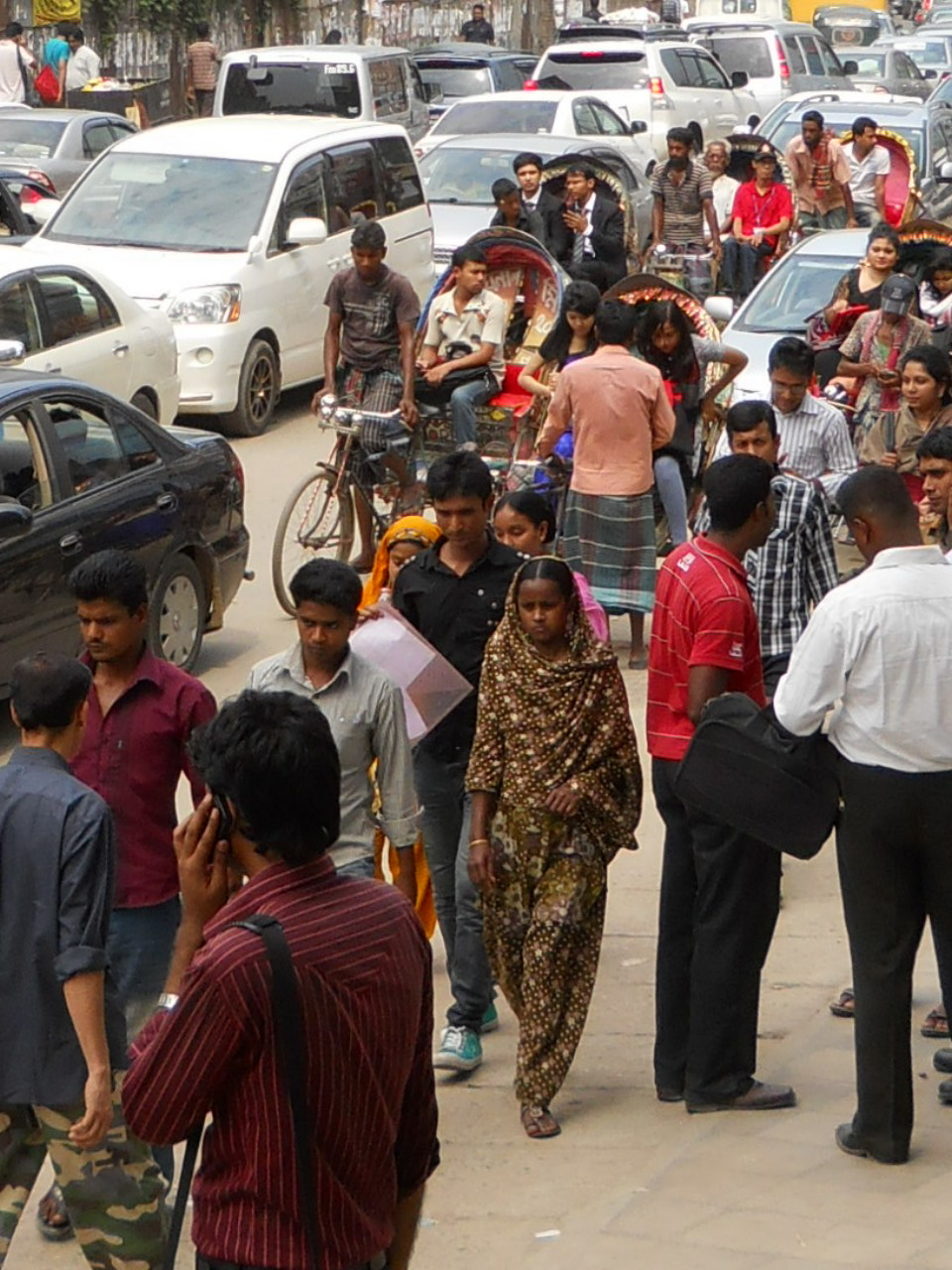
In a previous Post (See Travel 5) I wrote,“... another aspect of Bangladeshi life that will never be forgotten, is the low value of human life. Every time I picked up a daily newspaper, I was astonished by the number of murders that were taking place every day (every day). There are two categories; firstly the group attacks on males resulting from some petty street argument and, secondly, the 'honor' killings of females, more often than not, housemaids. Then, only if reported, do the police become involved, but only to document the incident (Rarely is there a report of a conviction). It is difficult not to mention religion in this context.” I should, now, try to present a more detailed picture of that terrible situation which is rarely described in the Western media.
 |
| Dhaka (Bashundhara) |
To do this, I randomly grabbed a local newspaper, the Daily Star (May 23rd, 2013), and spent some time analyzing the contents for evidence of the low value of human life. Here is the result:
- “Man dies in cop custody - Family alleges torture as it gave half the money demanded in bribe for his release.”
- “BNP to call another hartal* next week - The BNP last night decided to enforce a nationwide daylong hartal next week protesting the ‘ban’ on rallies in the capital for a month.”
- “Rapist gets life term in Ctg - A Chittagong court yesterday sentenced a man to life and fined him Tk 1 lakh for raping a five-year-old girl.”
- “Road crash kill four - A man was killed and three others were injured as a truck rammed a Nasimon at Maligasa intersection in Pabna yesterday.” (Yes, I did notice the title error, Ed.)“MC College student stabbed to death - A student of MC College was stabbed to death by miscreants in the city’s Pathantola area yesterday.”
- “Injured CU student dies - A Chittagong University student, who was injured after falling off the railing in the corridor of his hall on Tuesday night, died in Chittagong Medical College Hospital early yesterday.”
- “Vandalism marks BNP’s hartal - At least 15 CNG auto-rickshaws were vandalized and another torched by pickets in Keraniganj upazila during yesterday’s daylong hartal in Dhaka district called by BNP.”
- “Sylhet court frames charges against six - A Sylhet court framed charges against six people in a case filed against them on a charge of killing journalist Foteh Osmani in Sylhet city on April 18.”
- “Accused in Rekkat murder case held - Detective Branch (DB) of police has arrested a youth in connection with local Swechsebok League leader Rekkat murder case.”
- “Two ‘smugglers’ killed in ‘shootout’ with BGB - Two alleged smugglers were killed in a ‘shootout’ between members of Border Guard Bangladesh (BGB) and a gang of smugglers ....”
- “18-party men sued - Around 200 leaders and activists of 18-party Alliance were sued yesterday on charge of vandalizing vehicles and blasting cocktails on Tuesday.”
- “Youth ‘commits suicide’ - A youth allegedly took his own life by taking poison over a family feud in Pakpara village in Kalidashpur ....”
- “Man kills daughter - A two-year-old girl was killed allegedly by her father at Bhatpara village ....”
- “Youth electrocuted - A dish line worker was electrocuted in Kawkhali upazila on Tuesday night.”
- “Housewife killed for dowry - A housewife has been killed allegedly by her husband for dowry at Asadpur village under KHaliajuri upazila.”
- “30 extrajudicial killings so far this year - Bangladesh security forces perpetrated at least 30 extrajudicial killings and 10 forced disappearances and carried out wide-spread torture in 2012, according to the human rights organization Amnesty International.”
- “2 killed in ‘shootout’ - They were suspected of murder, abduction, says RAB.”
- “Rajshahi Jubo League leader shot dead - A Rajshahi leader was gunned down in a factional clash at Chandipur in Rajshahi city yesterday afternoon.”
Please note that this is an average daily record, and I have other newspapers that describe similar statistics. It is surprisingly noticeable that deaths and injuries on the railways are not mentioned in this instance. Incidentally, this newspaper, ironically, had a photo of Mahatma Gandhi on the front page.
 |
| Dhaka (Bashundhara) |
Please comment using the 'comment' button below.
Sunday, 30 June 2013
Education 5 - WARNING - Bangladesh
This is a piece of advice for diligent, volunteer teachers, and a warning to unscrupulous, corrupt owners of schools in underdeveloped countries, that corruption can not be silenced.
Last year (2012) I was invited to teach English as a Second Language (ESL) actually, English as a Foreign Language (EFL), but the school was unaware of the difference, at the privately-owned, International Medical College and Hospital (IMC) in Dhaka, Bangladesh, managed by International Medicare Limited (IML).
The writing was on the wall (So to speak) even before leaving Canada, as the incompetent General Secretary, Mr. Nurul Amin, decided that he could argue with the Bangladesh High Commission in Ottawa, Canada, regarding the requirement for IMC to provide a work permit to satisfy my application for a visa.
After months of embarrassed wrangling, which included the inefficient henchman, Mr. Amin (Unaware that the Earth was round), waking the High Commission’s 1st Councillor in the middle of the night, causing the visa to be issued ... under duress. In other words, IMC executives were able to ask (Or bribe) for a favor from the Prime Minister’s office, as a matter of cronyism.
Arriving in Dhaka, I was introduced to a makeshift classroom in the reception area of the small IML office. Once again, my heart stopped a beat. As this was another example of misrepresentation.
Eventually, unsuspecting students were enrolled and classes began. Teaching was shared between myself and another visiting professor and, together, we also spent some time teaching at the dilapidated college hospital located in a very poor rural area more than one hour’s drive north of the city ... this, requiring a 5:30 a.m. start. Incidentally, the photos on the company's Website have been touched-up in order to avoid showing the incomplete, decades-old, building construction or the excrement-filled 'pond'.
It was not very long before we met the self-styled Managing Director, Mr. M.A. Rab (Major General, Retired), who, without an ounce of experience, decided that he would redesign the curriculum (And much more). Although we fought against this, it was useless. The whole company executive of retired army officers were as corrupt and an extreme example of cronyism that was ever known. It seems a cultural phenomena in Bangladesh.
Eventually, our diligent students lost patience and the unintelligent Mr. Rab cancelled the classes, leaving my colleague and I penniless, with expired visas, in a country well known for its very dangerous political hartals (strikes) which should be described here in a later post.
We felt very bad for the students who had paid large tuition fees which were not refunded. Additionally, we could not understand the logic of stopping the much-needed education of poor students by foreign volunteer teachers. After all, we had paid for our own return air fares, accommodation, and food, etc., out of a monthly stipend of $200.
Therefore, please remember the name; the 'University of Hard Knocks' and, by the way, there are many honest colleges in Bangladesh (See British Council).
Friday, 28 September 2012
Education 4 - Overseas Teaching Qualifications
The other day, I received an invitation to register for an IELTS course (No doubt my address was found from a simple Internet search, regardless of my wish to become a student or not). Having recently returned from Bangladesh, and just about to go back, I decided to investigate this course.
This is how it was described to me:
IELTS Writing Preparation Course
Certificate Course
No. of Classes/ Sessions: 13
Total Hours: 16
Days: SUN-MON-TUE of every week
Time: 5:00PM - 6:15PM
Registration Fees: Tk. 5000.00/Participant (US$61.00)
Get 5% discount by paying online
Get 5% discount by paying online
This unique course aims at developing English writing skills for the International English Language Testing System (IELTS). The writing section forms an important part of the exam as it judges the candidate's ability to communicate in the written form. It evaluates how well the candidate is able to structure and frame his/her thoughts and how clearly he/she is able to express his/herself. This is especially important for individuals appearing for the Academic module as their ability to write well matters a lot in their professional lives.
Candidates appearing for the Academic module are the ones who are applying for admission for higher education or for professionals who are looking to get further training in English speaking countries.
By the end of this course the participants will learn Planning of Writing, Organization of Thoughts, Quality of Arguments, Sentence Structure, and Time Management.
Now this seems well and good, but my cynicism makes me wonder which IELTS book it is copied from. Because, out of curiosity, I asked for details of the teacher, and received the following reply (Certain details deleted to protect the innocent):
Trainer Details: MBA ...., BBA .... He is working as an outworker in both Academic Institutions and in Local Organizations. Former Lecturer of .... Worked as a HR associate at the HR Department of .... He attained Trainee worked at “Housekeeping, Purchase, and Laundry Departments” at ... Hotel, from March 01, 2010 to May 31, 2010. As an Intern he worked at “Customer Care and Sales Department” at ... from 12th September 2006 to 4th December 2006. He also Participated in 2 (two) weeklong “Live in Field Experience” (LFE) Program, January 2006, conducted on 25 families at Village: ... under total supervision of Bangladesh Academy for Rural Development ....
I wrote back saying that I could not send my students to this course as the Bangladeshi teacher not only had no teaching qualifications, but there is no evidence that he has an English language qualification either. The frequently used phrase, "No experience necessary", seems to be taken too literally in this case.
This course, although well-meaning, is an example of the urgent need for foreign teachers to work in Bangladesh, but it is a very poor country, and other countries, for example, Thailand, China, or Korea, can offer much better financial incentives. Nevertheless, the rewards for teaching in underdeveloped countries from the diligent students and grateful faculty make up for the small financial gain.
Saturday, 11 August 2012
Travel 6 - South East Asia (Thailand)
Firstly, I should mention that this is not meant to be a travelogue intending to entice you to visit, it is just my personal memory of an event. Travelling to Thailand is a wonderful experience. Secondly, unlike Bangladesh, the immigration controls were very friendly, because Canadians do not require an entry visa. And, thirdly, although I had travelled to the country before, to the very ancient city of Chiang Mai (which is very typical of cities in this part of Asia), this time, my friend and I flew to Bangkok (the capital) and it was a tremendous surprise. From the huge modern Suvamabhumi International Airport to a city of high-rise buildings and good roads, we instantly noticed a comparison between the unruly traffic congestion of Dhaka with the polite diligent drivers of Bangkok.
 |
| Day Time - Lumphini Park, Bangkok |
Our multi-starred hotel was great, and arriving a couple of days before the international conference, we were able to look around and relax. During the conference, I toured on my own, and my friend became almost a stranger ... but we had the evenings together, and took advantage of a river cruise to enjoy views of the many illuminated temples, etc.
 |
| Night Time - River Chao Phraya, Bangkok |
Later, we stayed on for a few extra days, and flew down to the town of Hat Yai in the southern province of Songkhla, where my friend had previously taught at a university, and met some old friends (Actually, a one hour drive further south). They had deliberately not been warned of our arrival in order to avoid great welcoming celebrations, but the abundance of joyous tears everywhere was extremely moving, and a perfect example of Thai hospitality. Then, we had to force ourselves away on an overnight train to Bangkok.
A final evening at a Thai restaurant was mandatory, of course.
 |
| When in Thailand, Eat Thai Food ... Of Course |
Then, back to the anticlimax of Bangladesh, which lasted a few more days until returning to Canada (Another anticlimax).
 |
| Early Morning Arrival - London, Ontario |
Sunday, 5 August 2012
Travel 5 - South East Asia (Bangladesh)
The 1:00 AM arrival, from China, at Hazrat Shahjalal International Airport in Dhaka, Bangladesh, was my worst airport experience ever. Travel agencies indicate accurately that one can obtain a Visa on Arrival at the airport, but nothing is said about the inability to obtain Bangladesh taka at any currency exchange outside the country. Therefore, at 1:00 AM, the main currency exchange point is closed ... and, thus, the great ‘red tape’ odyssey began.
More than one hour later, I exited Immigration control, found my suitcase, and walked outside to be greeted by a huge number of aggressive taxi hustlers, not to mention the residual humidity and high temperature. Eventually, I met the driver sent to take me to the foreign teachers residence ... another 45 minutes.
Arriving at the residence, I was met by a tall, muscular, bare-chested, eunuch-looking porter, who carried my heavy suitcase up three flights of stairs. The apartment had two en-suite bedrooms, occupied by two nursing teachers, and one spare room for me. Thus, my outside bathroom contained a ‘squat’ toilet and a cold bucket shower. I just ‘crashed’ onto the bed for the remainder of the morning.
Next day, although having been advised to rest, I walked to the campus of the International University of Business, Agriculture and Technology (A fifteen-minute walk). Rickshaws were available, but I was still trying to come to terms with the value of the taka (It seems that the rickshaw ride would cost approximately 20 cents Canadian).
 |
| Hey, taxi! |
Then, I was met by the senior foreign teacher, the head of a Canadian-sponsored nursing faculty, who knew nothing about my terms of employment.
Eventually, I was introduced to the Vice-Chancellor, who explained that, although there was an English language faculty of 16 professors, there was not a specific English language programme. He wanted to create a BA (Honors) programme as soon as possible but, at the moment, English was taught as a minor subject. My task was to audit the English classes, both students and teachers, and produce a report providing advice for improving the teaching.
The audit of English language classes concentrated on the teaching of oral English and, although there were instances when regular classes concentrated on the teaching of reading and writing, it was possible to observe teaching styles. Readability of PowerPoint presentations was particularly interesting.
 |
| Excellent Students |
The audit of English language classes concentrated on the teaching of oral English and, although there were instances when regular classes concentrated on the teaching of reading and writing, it was possible to observe teaching styles. Readability of PowerPoint presentations was particularly interesting.
 |
| University Tagore Celebration |
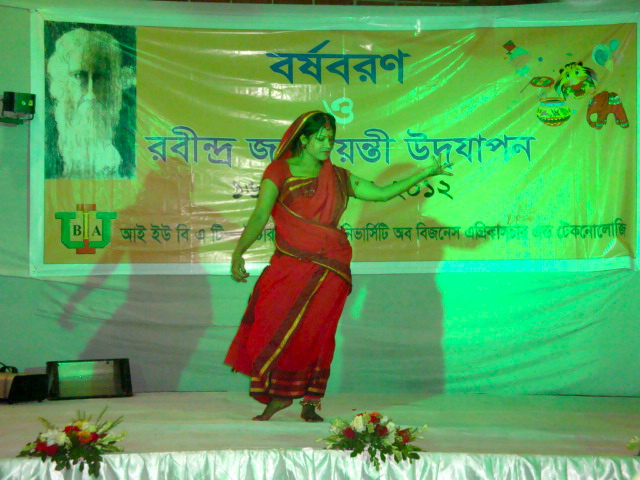
During this period, the university celebrated the anniversary of Rabindranath Tagore, a writer, poet, and composer, who won the first Nobel Prize for Literature for a non-European in 1913. I was introduced as the guest of honor ... and it was.
 |
| Tagore Celebration Student Participants |
I finished my report four weeks later and, although requested (invited) to stay and teach for the remaining four weeks, I found that the negative conditions found in my report were very difficult to overcome within the short period remaining. Therefore, I did not hesitate to accept an invitation to move downtown to my friend’s apartment ... with its modern conveniences.
Relocating to the relatively modern down town area, nevertheless, had its drawbacks. Although 90% of the population are Muslim, according to the Constitution it is a secular country, and it is not hard to imagine a mosque on (almost) every city block. Normally, I could live with that, but this is the 21st century and the imams have discovered electronics (Loudspeakers). Now, I could live with that too, if the range of sound from each mosque did not overlap, but they do and the sound of calls to prayer is similar to the echos of the Grand Canyon. Of course, there will be at least one reader who will chide me for being critical of the traditions of another country. Nevertheless, the reverberating sound of the calls outside one's bedroom window every (every) morning starting at 5:00 AM ... is extremely irritating.
Incidentally, another aspect of Bangladeshi life that will never be forgotten, is the low value of human life. Every time I picked up a daily newspaper, I was astonished by the number of murders that were taking place every day (Every day). There are two categories; firstly the group attacks on males resulting from some petty street argument and, secondly, the 'honor' killings of females, more often than not, housemaids. Then, only if reported, do the police become involved, but only to document the incident (Rarely is there a report of a conviction). It is difficult not to mention religion in this context.
Relocating to the relatively modern down town area, nevertheless, had its drawbacks. Although 90% of the population are Muslim, according to the Constitution it is a secular country, and it is not hard to imagine a mosque on (almost) every city block. Normally, I could live with that, but this is the 21st century and the imams have discovered electronics (Loudspeakers). Now, I could live with that too, if the range of sound from each mosque did not overlap, but they do and the sound of calls to prayer is similar to the echos of the Grand Canyon. Of course, there will be at least one reader who will chide me for being critical of the traditions of another country. Nevertheless, the reverberating sound of the calls outside one's bedroom window every (every) morning starting at 5:00 AM ... is extremely irritating.
Incidentally, another aspect of Bangladeshi life that will never be forgotten, is the low value of human life. Every time I picked up a daily newspaper, I was astonished by the number of murders that were taking place every day (Every day). There are two categories; firstly the group attacks on males resulting from some petty street argument and, secondly, the 'honor' killings of females, more often than not, housemaids. Then, only if reported, do the police become involved, but only to document the incident (Rarely is there a report of a conviction). It is difficult not to mention religion in this context.
During my stay, my friend was required to attend a conference in Bangkok. And as the hotel, etc., was paid for, it seemed natural that I should accompany her (Probably explained in part Travel 6).
Saturday, 24 March 2012
Education 3 - Volunteer Teaching
I was recently introduced to a university in Bangladesh that was in need of a volunteer English language teacher. But, after sending my resume, the reply stated that a PhD. was required, although a MA. English or MEd. with a TEFL certification, would be acceptable.
Naturally, I was very surprised, because in essence, additionally, they were saying that besides the academic qualifications, I would be required to pay my own travel costs (without reimbursement) and accept no salary. If I were sarcastic, I would say that there must be hundreds of doctoral professors just queuing up to fill this post.
I feel it necessary to amplify my reason for surprise with a couple of examples. I have devoted my life to an aerospace-related career, culminating in the writing of a user guidebook that, today, resides in the library onboard the International Space Station ... and a PhD. was not required to do that. Recently, I returned from spending many productive years in China, successfully teaching English students from junior to postgraduate levels ... and a PhD. was not required to do that. Maybe I should add, that I judge my teaching success from the number of Chinese students who still write to me asking me about a return visit.
Concerned about this, I searched the Internet for similar opportunities, and discovered to my additional surprise that, previously, I was simply experiencing the tip of an iceberg. It seems, generally, in order to volunteer for posts overseas one must associate with one of the many NGO’s in this business. These NGO’s, although accepting of my lowly BA. degree, not only require that one pays for the airfare, but also between $500 and $1,500 per month for the “privilege” (actual quote) of teaching at the colleges. No doubt, it must be a privilege to live and work in a country with a 5-month monsoon season, a mosquito-infested environment, deep mud for roads, no safe drinking water, and electricity blackouts every day. I suggest that there should be a serious investigation of the definition for the term ‘non-profit’.
I guess that there is nothing like the feeling of a teacher scorned.
Postscript - Since writing the above, I have been invited as a Visiting Fellow to another university in Bangladesh, in May, with more suitable conditions. You may expect to read a blog with exciting details in the autumn of this year.
Subscribe to:
Posts (Atom)