The 1:00 AM arrival, from China, at Hazrat Shahjalal International Airport in Dhaka, Bangladesh, was my worst airport experience ever. Travel agencies indicate accurately that one can obtain a Visa on Arrival at the airport, but nothing is said about the inability to obtain Bangladesh taka at any currency exchange outside the country. Therefore, at 1:00 AM, the main currency exchange point is closed ... and, thus, the great ‘red tape’ odyssey began.
More than one hour later, I exited Immigration control, found my suitcase, and walked outside to be greeted by a huge number of aggressive taxi hustlers, not to mention the residual humidity and high temperature. Eventually, I met the driver sent to take me to the foreign teachers residence ... another 45 minutes.
Arriving at the residence, I was met by a tall, muscular, bare-chested, eunuch-looking porter, who carried my heavy suitcase up three flights of stairs. The apartment had two en-suite bedrooms, occupied by two nursing teachers, and one spare room for me. Thus, my outside bathroom contained a ‘squat’ toilet and a cold bucket shower. I just ‘crashed’ onto the bed for the remainder of the morning.
Next day, although having been advised to rest, I walked to the campus of the International University of Business, Agriculture and Technology (A fifteen-minute walk). Rickshaws were available, but I was still trying to come to terms with the value of the taka (It seems that the rickshaw ride would cost approximately 20 cents Canadian).
 |
| Hey, taxi! |
Then, I was met by the senior foreign teacher, the head of a Canadian-sponsored nursing faculty, who knew nothing about my terms of employment.
Eventually, I was introduced to the Vice-Chancellor, who explained that, although there was an English language faculty of 16 professors, there was not a specific English language programme. He wanted to create a BA (Honors) programme as soon as possible but, at the moment, English was taught as a minor subject. My task was to audit the English classes, both students and teachers, and produce a report providing advice for improving the teaching.
The audit of English language classes concentrated on the teaching of oral English and, although there were instances when regular classes concentrated on the teaching of reading and writing, it was possible to observe teaching styles. Readability of PowerPoint presentations was particularly interesting.
 |
| Excellent Students |
The audit of English language classes concentrated on the teaching of oral English and, although there were instances when regular classes concentrated on the teaching of reading and writing, it was possible to observe teaching styles. Readability of PowerPoint presentations was particularly interesting.
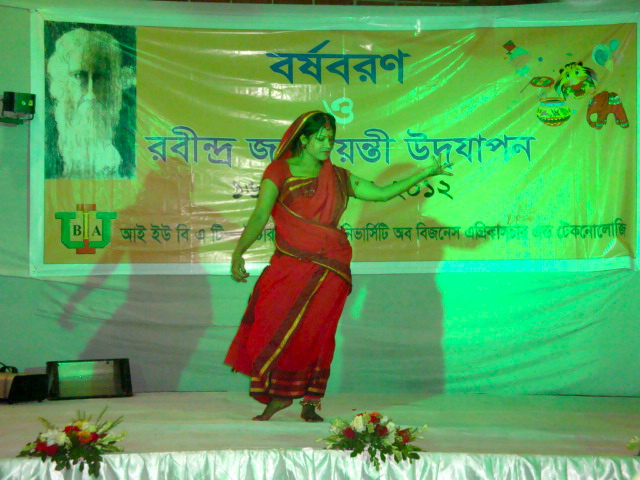 |
| University Tagore Celebration |
During this period, the university celebrated the anniversary of Rabindranath Tagore, a writer, poet, and composer, who won the first Nobel Prize for Literature for a non-European in 1913. I was introduced as the guest of honor ... and it was.
 |
| Tagore Celebration Student Participants |
I finished my report four weeks later and, although requested (invited) to stay and teach for the remaining four weeks, I found that the negative conditions found in my report were very difficult to overcome within the short period remaining. Therefore, I did not hesitate to accept an invitation to move downtown to my friend’s apartment ... with its modern conveniences.
Relocating to the relatively modern down town area, nevertheless, had its drawbacks. Although 90% of the population are Muslim, according to the Constitution it is a secular country, and it is not hard to imagine a mosque on (almost) every city block. Normally, I could live with that, but this is the 21st century and the imams have discovered electronics (Loudspeakers). Now, I could live with that too, if the range of sound from each mosque did not overlap, but they do and the sound of calls to prayer is similar to the echos of the Grand Canyon. Of course, there will be at least one reader who will chide me for being critical of the traditions of another country. Nevertheless, the reverberating sound of the calls outside one's bedroom window every (every) morning starting at 5:00 AM ... is extremely irritating.
Incidentally, another aspect of Bangladeshi life that will never be forgotten, is the low value of human life. Every time I picked up a daily newspaper, I was astonished by the number of murders that were taking place every day (Every day). There are two categories; firstly the group attacks on males resulting from some petty street argument and, secondly, the 'honor' killings of females, more often than not, housemaids. Then, only if reported, do the police become involved, but only to document the incident (Rarely is there a report of a conviction). It is difficult not to mention religion in this context.
Relocating to the relatively modern down town area, nevertheless, had its drawbacks. Although 90% of the population are Muslim, according to the Constitution it is a secular country, and it is not hard to imagine a mosque on (almost) every city block. Normally, I could live with that, but this is the 21st century and the imams have discovered electronics (Loudspeakers). Now, I could live with that too, if the range of sound from each mosque did not overlap, but they do and the sound of calls to prayer is similar to the echos of the Grand Canyon. Of course, there will be at least one reader who will chide me for being critical of the traditions of another country. Nevertheless, the reverberating sound of the calls outside one's bedroom window every (every) morning starting at 5:00 AM ... is extremely irritating.
Incidentally, another aspect of Bangladeshi life that will never be forgotten, is the low value of human life. Every time I picked up a daily newspaper, I was astonished by the number of murders that were taking place every day (Every day). There are two categories; firstly the group attacks on males resulting from some petty street argument and, secondly, the 'honor' killings of females, more often than not, housemaids. Then, only if reported, do the police become involved, but only to document the incident (Rarely is there a report of a conviction). It is difficult not to mention religion in this context.
During my stay, my friend was required to attend a conference in Bangkok. And as the hotel, etc., was paid for, it seemed natural that I should accompany her (Probably explained in part Travel 6).

