Showing posts with label Airbus. Show all posts

Wednesday, 16 September 2020

The Journey From Knowledge Evolution To Revolution

Technical Publication Trends


A recent article, published in Aerospace Week Intelligence Network, drew my attention as it focussed on the subject of my professional career … the production of technical publications.


Firstly, I shall reproduce excerpts that address specific content related to my personal experiences, i.e., Technical Author (FISTC), Publications Manager, and Teacher of English as a Foreign Language, before I follow with my own comments.


“Technical publications supporting the operations and maintenance of complex assets in the aerospace and defense industries play an instrumental role in operational enablement and mission achievement. These tech pubs represent the organization's institutional knowledge. As senior staff retire and take a wealth of knowledge with them, these organizations realize technical publications are critical to sustaining newer team members' productivity. Luckily, modern technologies are enabling new ways to utilize tech pubs in productive and innovative ways.”

Historically, tech pubs have been used passively in the maintenance process. An issue or task arises, a work order is generated with the parts and tools required and the tech is assigned to complete the effort. The technician accesses the tech pub as a reference, either on paper or in the IETM. In other words, the information is passively pulled into the process, not proactively pushed.”

“As we move further into the fourth industrial revolution, assets are becoming more intelligent with innovations like IoT, AI, big data analytics, remote diagnostics and other emerging technologies. Proactive delivery of technical knowledge is possible as the assets themselves can now communicate intelligently with digitalized content. For example, our customers have embedded our technology into asset platforms so the diagnostics data in the tech pub can work with the onboard monitoring systems to identify emerging issues. There is a lot more to this topic than I can cover here, so I suggest checking out my white paper that explains how technical content can assist in predictive and Condition Based Maintenance Plus (CBM+).”

“On top of the labor shortage, 80% of operational, maintenance and support personnel in the global aerospace and defense industry are non-native English speakers, but all aviation industry technical documentation is in English. Did you know it takes up to two years to train non-native English speakers to build competence in Simplified Technical English or STE?”

“As a result, I had several of my defense manufacturing clients look at advances in Machine Translation to deliver dual language technical publications within their Foreign Military Sales or FMS programs. FMS product support is another example because email, live chat and document translation are now vital when exchanging information between FMS customers and their Factory Support Representatives.”

By Bob Hogg, Director A&D Market Strategy - SDL

As a non-academic student of linguistics, I wince at the intent of the language usage prescribed above.  I assume that we have all used our iPhone to translate “Hello” to “Ni hao” or asked “Siri” for “Tomorrow’s weather”, but please, not to replace and adjust microscopic tolerances of a gas-turbine engine, etc. !

Why ?  Because the terms A.I., S.T.E. and Machine Translation imply the eventual removal of human technical language academics.  Professionals who remember hundreds of instances when near-fatal (and fatal) accidents occurred that resulted from poorly-written user guides or maintenance manuals.  For example, the Airbus that had insufficient fuel, or the Challenger that activated reverse-thrust instead of flaps.  Imagine yourself as the captain in a cockpit when emergency lamps are flashing and a robot is screaming “PULL UP. PULL UP” at you.  There are hundreds (thousands) of these examples … and they continue.  Personally, I remember working with Chinese technicians (in China) on G.E. gas-turbines, who worked diligently … as best that they were able … but ….

Are you surprised by my wincing at the thought ?

Monday, 21 October 2019

Boeing B 737 MAX Controversy


We are beginning to discover that there is more to the Boeing B 737 MAX controversy than was originally believed.  I say believed because, now, it is known that many facets of the development were not known by all concerned … and, even at the time of writing, new aspects are coming into focus.


Grounded Southwest Boeing 737 MAX in California


Boeing has always believed that Airbus was a thorn in its’ side, ever since the European consortium was created.  Therefore, it is essential that we start this very brief blog with an Airbus introduction, as it relates to the subject.


Grounded Boeing 737 MAX at remote location


Noting the success of the Boeing 737. it goes without saying that the Airbus A320 family was designed in direct competition to the Boeing 737.  Specifically, the A320neo (New Engine Option) and the Boeing 737 MAX derived from the 737NG (Next Generation) in 2010 (Into service in 2016).  That, Airbus was able to get a ‘jumpstart’ on Boeing with a innovative, very successful, propfan technology engine for a modern airframe, caused Boeing to rush into developing a new version of their own, the Boeing 737 MAX (Into service in 2017 … an amazingly short design period).  This was going to open a Pandora’s box … to say the least.

In order to fit the large CFB LEAP-!B engines, it was necessary to modify the original attachments further forward on the wing due to the increased height required above the ground (Not required for the newer A320neo).  This, no doubt affecting the CG (Centre of Gravity) and writing new software related to AOA (Angle of Attack) signals.  The wing roots also required strengthening with fork-shaped metal plates (These, recently, have cracks reported).  Notwithstanding, the mixed messages between the FAA and Boeing, the lack of communication between test pilots and design engineers, and the apparent belief that maintenance manuals do not need to have every piece of information, we can only hope that the human race will soon grow wings.


It has been reported that Boeing is studying a new design to replace the Boeing 737 family all together based on a composite design used in the ‘Dreamliner’ aircraft.  The least said about that problem-plagued aircraft the better, I believe.

Hopefully, you will enhance this brief blog with your additional wisdom.


Wednesday, 18 July 2018

Aerospace 19 - Airbus A220


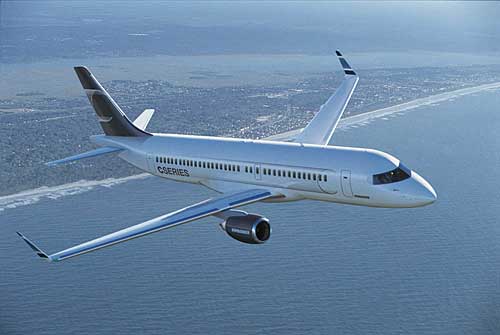
At one time there was Canadair — then De Havilland (Canada) — both merged to become Bombardier Aerospace.  Then, the innovative CSeries airliner emerged to challenge the two giants Airbus and Boeing.  Unfortunately, Bombardier suffered from financial teething troubles coupled with new engine problems that was especially developed for the airframe by Pratt & Whitney, not to mention WTO threats from Boeing (Aerospace 17) .

Finally, Airbus SE stepped in to buy a 51% share of Bombardier’s CSeries division (Bombardier continuing with total control of other aircraft divisions, e.g., Q-400, and CRJ, etc.).

Now, under control of Airbus, the aircraft titles C-100 and C-300 have been changed to A220-100 and A220-300 respectively.

It is going to be an interesting time, from now onwards, to see if this will have an affect for future sales.  It is quite evident that the A319 will eventually concede to the superiority of the A220-100, a position with which it shares.  

Today, an MOU for 60 A220-300 aircraft was signed by a group of investors led by the CEO of JetBlue for a planned new airline, so far unnamed (The rumour says ‘Moxy’).


Monday, 23 May 2016

Aerospace 14 - The Right Profit Metric


ⓒ Bombardier, Montreal, May 2016

It's useful to know what Boeing and Airbus wouldn't tell you.
What’s the Right Profit Metric? 
Cost Per Passenger.
Traditionally, the airline industry has concentrated on a cost-per-seat strategy because it was the only way to extract margin.  As a result of the lower cost-per-seat pursuit, many airlines were driven toward purchasing larger single-aisle aircraft.

But one size does not fit all.


On many routes, seats were flying for free.  Empty seats.  And if not free, the seats were on sale. And as everyone knows, sales procure low yields.  Consequently, a large part of the secondary market was dropped, or even ignored.


On the other hand, medium-haul markets are reaching a certain level of saturation.So where is the next level of growth?  What’s the best way to stimulate traffic and increase the number of passengers travelling through hubs?  Secondary and tertiary markets are the key.  In other words, it’s time to go deeper in the regions.


What really matters when looking for high yields at low risk is simple: the cost per passenger on board.


Right-Sized for Opening New Markets


Free from design constraints, the Bombardier C Series 5-abreast platform was developed specifically for the 100 -150 passenger market.  It is not a stretch, nor a shrink of a legacy program.  It’s the right aircraft at the right time.


A Low Risk Solution


With a 25 to 35% lower cost per passenger on board, the Bombardier C Series aircraft are the ideal complements to the larger A320/A321 and 737-800/737-900. The C Series family provides the freedom to think differently about network planning. Which means, airlines have a new way to grow and focus on the next opportunity for expansion.


Increase Your Yields


Entering into service in July of this year, the Bombardier C Series is the right tool to help you be the first to grow these new markets profitably. Now, you can return to these once deserted markets with the right sized aircraft and start increasing your yields.


Be the first to serve those markets where there is no competition, but plenty of opportunity.

Grateful thanks to Bombardier for producing this article.

Monday, 16 September 2013

Aerospace 6 - It's Innovation!


It’s a plane!  It’s the CSeries!  It’s innovation!  Yes, it’s another example of Bombardier creativity.  Today, the first CSeries aircraft took off, like a whisper, from Mirabel Airport in Quebec.  It was a few months behind the original schedule but this compares quite favourably with the years of delay for Boeing’s B-787 ‘Dreamliner’, which continues to reveal problems.

The flight lasted for a few hours, and the test pilots enthusiastically reported a perfect flight.

Illustration by Bombardier Inc.
What happens next?  Well, in my opinion, many airlines who have been placing meaningless Letters of Intent with Airbus, Boeing, et al., will be reassessing their biased agendas and sending representatives to Montreal (If they are not already there).  After all, you are reminded of the old technology inherent in the Airbus and Boeing aircraft that will not become available until 2017 ... compared to the 20% more efficient CSeries becoming available next year (2014).

Look out, also, for news from Porter Airlines, who have already announced their conditional order of 12 CSeries aircraft (Conditional on a runway extension at the Billy Bishop airport) and, then, imagine the impact of WestJet trying to bring their new Q400’s into Billy Bishop.  It's going to be interesting.

Stay tuned (As they say).


Wednesday, 4 September 2013

Aerospace 5 - WestJet Moves


Last month, WestJet Airlines Ltd. placed a letter of intent to purchase 65 B-737 aircraft from the Boeing Company, and delivery of the first aircraft will be in September 2017.  As a result, I was empowered to research this segment of the market concerning the future of both WestJet and Bombardier Aerospace.  What follows is a pocketbook guide to my (admittedly biassed) thoughts.
WestJet B-737 NG, Early Morning Approach into London, Ontario,

Boeing introduced the first B-737 in 1967 and it became the best-selling commercial jet in aviation history.  Over this period, many modifications were made to the aircraft to increase seating and range.  In 1997, when it became clear that the Airbus A-320 was a serious threat, Boeing introduced the Next Generation (NG) aircraft, the main differences could be seen in a new wing with blended winglets, a quieter engine, and modern avionics.  One interesting problem that happened with the B-737 NG was due to the larger engine which, if placed in its original position, was too close to the ground.  This problem was solved by positioning the engine further forward on the wing.  In 2010, Airbus announced the new engine option for the A-320 NEO, thus, increasing the competition with the B-737 NG.  In 2011, Boeing announced the B-737 MAX.  This version has another new engine and, because of closeness of the engine to the ground, has a greatly extended nose wheel  length.  

Delivery of the first aircraft is due to begin in 2017.  Meanwhile, Bombardier has been working quietly in the background on the design of a new 100-seater CSeries aircraft, to add to its solid fleet of new technology aircraft such as the Challenger, CRJ, Learjet, and Q400 aircraft.The idea for the CSeries aircraft started in 2004 using some of the high technology used on the company’s other designs, but totally designing a new aircraft from nose to tail, using a great deal of carbon fibre, and incorporating a newly designed, highly efficient engine.  The aircraft uses 46% composite materials, 24% aluminium-lithium which allows a 15% lower seat-mile cost, a significant reduction in maintenance costs ... and a 20% less fuel per trip than any of the Boeing, Airbus, and Embraer competitors.  Not to mention that, as I write, Transport Canada has issued the permit to fly for the first aircraft, which should happen within days of writing this, and a proposed entry into service for next year (2014).

Therefore, to Greg Saretsky, the CEO of WestJet, I am bound to ask this obvious question;  Why, when you now have introduced Q400’s into your fleet, have you decided to order an old, patched-up design, B-737 MAX for 2017, when the 20% better Canadian CSeries will become available next year?


Sunday, 4 September 2011

Aerospace 2 - Opposing Two Giants

Last week, Boeing revealed its decision regarding the question of a new generation aircraft, the B-737 MAX, that will be competitive with the proposed Airbus A-320 NEO.  There is, naturally, some controversy regarding this decision that questions the introduction of either aircraft.

In my opinion, there is a connection between these compromise plans and Bombardier's development of a narrow body aircraft, the CSeries.  Neither of the two giants could compete with the CSeries in its class for a number of reasons.  One reason that appeals to travellers is the four or five abreast seating in the CSeries that compares with the normal six abreast seating provided by the competition.  Airbus and Boeing argue that they are not competing in the 100-seat category but, if so, why have they rushed Band-Aid solutions to improving their A-320 and B-737 designs.  Probably, because should the CSeries be successful, and it will, Bombardier will introduce an extended version that, it could be suggested, will close the gap.

Originally, Boeing developed the B-737 with different fuselage-length variants and this natural progression was also seen in the A-320 series.  Over time, each manufacturer improved their design in small increments, for example, the introduction of composite materials and fly-by-wire systems.

Meanwhile, in fact, for more than two decades, Bombardier had entered the market with a range of small business jets, created completely from original designs and, most importantly, conducting advanced research in fuselage construction, composite materials, and closely coordinating with gas turbine manufacturers for fuel efficient engines, such that the introduction of their CSeries aircraft will be a leader in its class (Brazil's Embraer and China's Comac aircraft companies may compete in this market segment but, at the moment, can not compete, totally, with the advanced technologies employed in the CSeries).

Both Airbus and Boeing are showing good order books, especially Airbus, but we should note that they are not all firm orders.  The B-737 MAX is very much a compromise redesign, especially when we look at the new engines.  The main comparison with the A-320 NEO is the smaller fan blade diameter.  Although the new engine is larger than previous models, it is smaller than fitted to the A-320 NEO (168 cm compared to 205 cm fan blade diameter respectively).  The reason for this is that the height of the wing is less and the B-737 MAX requires a 42.9 cm (16.9 in) ground clearance.  It has been said, unconvincingly, that a larger engine would create greater drag but, equally, would be less efficient than that of the A-320 NEO.

In my opinion, the argument that the two giants are using tested designs is quite poor as there is little to compare, for example, the B-737 of 1964 with that of today.  Equally, the CSeries is using technologies that have been well proven for many years on their Global Express series of aircraft.

Therefore, the introduction of Bombardier's CSeries will be a leap forward in advanced design with superior qualities superior in its class, such that, I am sure, if the fly on the boardroom wall of Airbus and Boeing could talk, there would be some smiling faces in Montreal.