Showing posts with label CSeries. Show all posts

Tuesday, 20 February 2018

Aerospace 18 - Delta CSeries


Bombardier expects to begin delivering CSeries aircraft to Delta Air Lines this year, saying there is no longer any restriction to delivering the CS100 straight from its Canadian assembly line to the Atlanta-based airline.

“Clearly, the Delta aircraft are in the skyline for 2018,” Bombardier CEO Alain Bellemare told analysts February. 15th.  The recent 4-0 decision by the US International Trade Commission (ITC) canceling proposed tariffs on CSeries exports to the US removes any restrictions on CSeries deliveries.

The uncertainty surrounding the US Commerce Department’s intended duties on the CSeries forced Bombardier and Delta to postpone the originally planned April 2018 start of CS100 deliveries to Delta, which has 75 CS100s on firm order. 

Bellemare emphasized that plans for the Alabama, facility, are “moving full speed ahead,” explaining, “We believe it’s the right strategy to have a US facility to serve US customers.” But at least the first number of Delta deliveries can now come from Canada, he said.

Bellemare expects the Bombardier-Airbus CSeries deal to be approved by regulators later this year. “Integration planning is going extremely well,” he said. “We are ready to hit the ground running once we close, including construction of the Alabama facility as soon as possible.  2018 will be a pivotal year for Bombardier,” he said, forecasting that the company will move into “a strong growth phase” this year.


Monday, 16 September 2013

Aerospace 6 - It's Innovation!


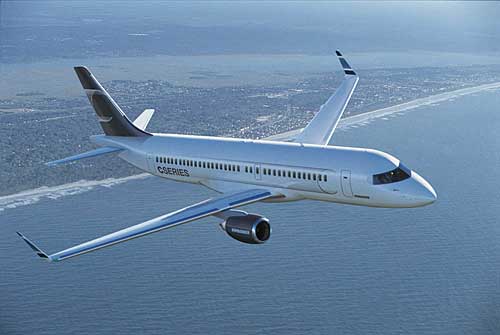
It’s a plane!  It’s the CSeries!  It’s innovation!  Yes, it’s another example of Bombardier creativity.  Today, the first CSeries aircraft took off, like a whisper, from Mirabel Airport in Quebec.  It was a few months behind the original schedule but this compares quite favourably with the years of delay for Boeing’s B-787 ‘Dreamliner’, which continues to reveal problems.

The flight lasted for a few hours, and the test pilots enthusiastically reported a perfect flight.

Illustration by Bombardier Inc.
What happens next?  Well, in my opinion, many airlines who have been placing meaningless Letters of Intent with Airbus, Boeing, et al., will be reassessing their biased agendas and sending representatives to Montreal (If they are not already there).  After all, you are reminded of the old technology inherent in the Airbus and Boeing aircraft that will not become available until 2017 ... compared to the 20% more efficient CSeries becoming available next year (2014).

Look out, also, for news from Porter Airlines, who have already announced their conditional order of 12 CSeries aircraft (Conditional on a runway extension at the Billy Bishop airport) and, then, imagine the impact of WestJet trying to bring their new Q400’s into Billy Bishop.  It's going to be interesting.

Stay tuned (As they say).


Wednesday, 4 September 2013

Aerospace 5 - WestJet Moves


Last month, WestJet Airlines Ltd. placed a letter of intent to purchase 65 B-737 aircraft from the Boeing Company, and delivery of the first aircraft will be in September 2017.  As a result, I was empowered to research this segment of the market concerning the future of both WestJet and Bombardier Aerospace.  What follows is a pocketbook guide to my (admittedly biassed) thoughts.
WestJet B-737 NG, Early Morning Approach into London, Ontario,

Boeing introduced the first B-737 in 1967 and it became the best-selling commercial jet in aviation history.  Over this period, many modifications were made to the aircraft to increase seating and range.  In 1997, when it became clear that the Airbus A-320 was a serious threat, Boeing introduced the Next Generation (NG) aircraft, the main differences could be seen in a new wing with blended winglets, a quieter engine, and modern avionics.  One interesting problem that happened with the B-737 NG was due to the larger engine which, if placed in its original position, was too close to the ground.  This problem was solved by positioning the engine further forward on the wing.  In 2010, Airbus announced the new engine option for the A-320 NEO, thus, increasing the competition with the B-737 NG.  In 2011, Boeing announced the B-737 MAX.  This version has another new engine and, because of closeness of the engine to the ground, has a greatly extended nose wheel  length.  

Delivery of the first aircraft is due to begin in 2017.  Meanwhile, Bombardier has been working quietly in the background on the design of a new 100-seater CSeries aircraft, to add to its solid fleet of new technology aircraft such as the Challenger, CRJ, Learjet, and Q400 aircraft.The idea for the CSeries aircraft started in 2004 using some of the high technology used on the company’s other designs, but totally designing a new aircraft from nose to tail, using a great deal of carbon fibre, and incorporating a newly designed, highly efficient engine.  The aircraft uses 46% composite materials, 24% aluminium-lithium which allows a 15% lower seat-mile cost, a significant reduction in maintenance costs ... and a 20% less fuel per trip than any of the Boeing, Airbus, and Embraer competitors.  Not to mention that, as I write, Transport Canada has issued the permit to fly for the first aircraft, which should happen within days of writing this, and a proposed entry into service for next year (2014).

Therefore, to Greg Saretsky, the CEO of WestJet, I am bound to ask this obvious question;  Why, when you now have introduced Q400’s into your fleet, have you decided to order an old, patched-up design, B-737 MAX for 2017, when the 20% better Canadian CSeries will become available next year?


Sunday, 4 September 2011

Aerospace 2 - Opposing Two Giants

Last week, Boeing revealed its decision regarding the question of a new generation aircraft, the B-737 MAX, that will be competitive with the proposed Airbus A-320 NEO.  There is, naturally, some controversy regarding this decision that questions the introduction of either aircraft.

In my opinion, there is a connection between these compromise plans and Bombardier's development of a narrow body aircraft, the CSeries.  Neither of the two giants could compete with the CSeries in its class for a number of reasons.  One reason that appeals to travellers is the four or five abreast seating in the CSeries that compares with the normal six abreast seating provided by the competition.  Airbus and Boeing argue that they are not competing in the 100-seat category but, if so, why have they rushed Band-Aid solutions to improving their A-320 and B-737 designs.  Probably, because should the CSeries be successful, and it will, Bombardier will introduce an extended version that, it could be suggested, will close the gap.

Originally, Boeing developed the B-737 with different fuselage-length variants and this natural progression was also seen in the A-320 series.  Over time, each manufacturer improved their design in small increments, for example, the introduction of composite materials and fly-by-wire systems.

Meanwhile, in fact, for more than two decades, Bombardier had entered the market with a range of small business jets, created completely from original designs and, most importantly, conducting advanced research in fuselage construction, composite materials, and closely coordinating with gas turbine manufacturers for fuel efficient engines, such that the introduction of their CSeries aircraft will be a leader in its class (Brazil's Embraer and China's Comac aircraft companies may compete in this market segment but, at the moment, can not compete, totally, with the advanced technologies employed in the CSeries).

Both Airbus and Boeing are showing good order books, especially Airbus, but we should note that they are not all firm orders.  The B-737 MAX is very much a compromise redesign, especially when we look at the new engines.  The main comparison with the A-320 NEO is the smaller fan blade diameter.  Although the new engine is larger than previous models, it is smaller than fitted to the A-320 NEO (168 cm compared to 205 cm fan blade diameter respectively).  The reason for this is that the height of the wing is less and the B-737 MAX requires a 42.9 cm (16.9 in) ground clearance.  It has been said, unconvincingly, that a larger engine would create greater drag but, equally, would be less efficient than that of the A-320 NEO.

In my opinion, the argument that the two giants are using tested designs is quite poor as there is little to compare, for example, the B-737 of 1964 with that of today.  Equally, the CSeries is using technologies that have been well proven for many years on their Global Express series of aircraft.

Therefore, the introduction of Bombardier's CSeries will be a leap forward in advanced design with superior qualities superior in its class, such that, I am sure, if the fly on the boardroom wall of Airbus and Boeing could talk, there would be some smiling faces in Montreal.


Saturday, 25 June 2011

Aerospace 1 - Postscript


The show in Paris is over and the controversy that was created, relative to the Bombardier CSeries, advises me that it would have been prudent to wait for the final day.
The usual battle between the Big Two companies (Boeing and Airbus) dominated the media and, in my opinion, benefited Bombardier by highlighting their need to reconsider emerging technologies.  The success of the A320neo with its new engine, juxtaposed with no response from Boeing for a B737 replacement was interesting.
Bombardier’s large customer, Republic, caused a stir by ordering 40 A320neo’s, which caused a negative reaction to Bombardier's stock price, and much debate amongst aviation pundits.  Nevertheless, the consensus indicates that the CSeries will prove, overwhelmingly, that its cost savings will save airlines millions annually, compared to both the A320neo and the B737 compromise models.
The negative reviews regarding delivery delays related to new airframe construction technologies were given out of context — the technologies would be new for Boeing and Airbus, but Bombardier already applies these technologies throughout its present fleet of 4-abreast seating — the CSeries has simply expanded to a 5-abreast mode.
At the show, Bombardier came away with 56 total orders (including options) for the CSeries, from eight different customers, and many more for their other, existing aircraft, such as the Global series of business jets.  With more than 200 orders (including options) for the CSeries, its future is secured, especially considering that the first flight is not scheduled until the end of 2012.
Personally, my curiosity is, now, directed to the ‘fly on the wall’ in WestJet’s boardroom as they discuss their future fleet of B737’s.  Would it not be a proud moment for Canada if our best domestic airline used the CSeries aircraft.

Monday, 20 June 2011

Aerospace 1 - Bombardier CSeries

My profile indicates that aerospace is a favorite subject of mine and, therefore, during this week of the Paris Air Show, it seems quite natural to write on this subject.

As we struggle to emerge from the recent recession, the aircraft industry is very cautious about predictions that attempt to balance future airline quantity requirements with related research into improving usage costs. Analysts predict that airlines will need $4 trillion worth of new aircraft during the next 20 years and, although there is an emphasis on eco-friendly aircraft, airlines focus on the financial bottom line. Thus, the two giants of the aircraft industry, Airbus and Boeing, should be concerned about the quiet ascendance of Bombardier into third place.

I have always been impressed by Bombardier’s innovation since visiting their early manufacturing facility at Cartierville in Montreal in the 1980’s (Originally, a small airfield used by Canadair). Their use of giant milling machines to produce fuselage side panels for the Challenger which did not require the conventional ribs and framing and, thus, reducing weight, together with laminar-flow wing surfaces for improved aerodynamics, was something that, being a sailplane pilot, impressed me quite a lot.

Thirty years of quiet innovation has brought Bombardier into serious competition with Airbus and Boeing, and the new CSeries aircraft is, in my opinion, bound to be a success. Not only is its composite airframe more advanced in design, but the new geared turbofan engine designed by Pratt & Whitney is causing the competition to swiftly play ‘catch up’. Airbus developing the new-engined A320neo compromise, and Boeing considering a whole new B-737 replacement (The new engine seems too large for the existing wing-to-ground clearance). Thus, it will be difficult for both companies to deliver ahead of the CSeries.

Finally, it is delightful to read that, on the first day, Bombardier has disclosed firm orders for ten of the CSeries at the Paris Air Show, with options for a further six. It is also noteworthy that Qatar Airlines CEO Akbar Al Baker, said, when asked whether he was considering another jet of similar size “The CSeries is a class above others in that category”.

It will be inspiring to dream of the industry’s ‘Big Three’.