Monday, 16 September 2013

Aerospace 6 - It's Innovation!


It’s a plane!  It’s the CSeries!  It’s innovation!  Yes, it’s another example of Bombardier creativity.  Today, the first CSeries aircraft took off, like a whisper, from Mirabel Airport in Quebec.  It was a few months behind the original schedule but this compares quite favourably with the years of delay for Boeing’s B-787 ‘Dreamliner’, which continues to reveal problems.

The flight lasted for a few hours, and the test pilots enthusiastically reported a perfect flight.
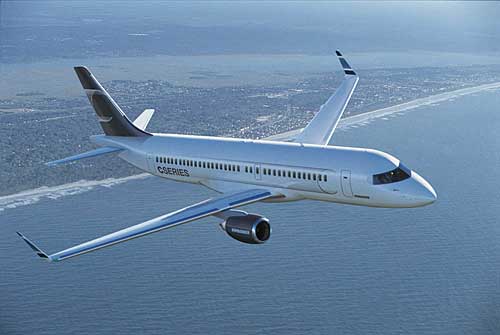
Illustration by Bombardier Inc.
What happens next?  Well, in my opinion, many airlines who have been placing meaningless Letters of Intent with Airbus, Boeing, et al., will be reassessing their biased agendas and sending representatives to Montreal (If they are not already there).  After all, you are reminded of the old technology inherent in the Airbus and Boeing aircraft that will not become available until 2017 ... compared to the 20% more efficient CSeries becoming available next year (2014).

Look out, also, for news from Porter Airlines, who have already announced their conditional order of 12 CSeries aircraft (Conditional on a runway extension at the Billy Bishop airport) and, then, imagine the impact of WestJet trying to bring their new Q400’s into Billy Bishop.  It's going to be interesting.

Stay tuned (As they say).


Wednesday, 4 September 2013

Aerospace 5 - WestJet Moves


Last month, WestJet Airlines Ltd. placed a letter of intent to purchase 65 B-737 aircraft from the Boeing Company, and delivery of the first aircraft will be in September 2017.  As a result, I was empowered to research this segment of the market concerning the future of both WestJet and Bombardier Aerospace.  What follows is a pocketbook guide to my (admittedly biassed) thoughts.
WestJet B-737 NG, Early Morning Approach into London, Ontario,

Boeing introduced the first B-737 in 1967 and it became the best-selling commercial jet in aviation history.  Over this period, many modifications were made to the aircraft to increase seating and range.  In 1997, when it became clear that the Airbus A-320 was a serious threat, Boeing introduced the Next Generation (NG) aircraft, the main differences could be seen in a new wing with blended winglets, a quieter engine, and modern avionics.  One interesting problem that happened with the B-737 NG was due to the larger engine which, if placed in its original position, was too close to the ground.  This problem was solved by positioning the engine further forward on the wing.  In 2010, Airbus announced the new engine option for the A-320 NEO, thus, increasing the competition with the B-737 NG.  In 2011, Boeing announced the B-737 MAX.  This version has another new engine and, because of closeness of the engine to the ground, has a greatly extended nose wheel  length.  

Delivery of the first aircraft is due to begin in 2017.  Meanwhile, Bombardier has been working quietly in the background on the design of a new 100-seater CSeries aircraft, to add to its solid fleet of new technology aircraft such as the Challenger, CRJ, Learjet, and Q400 aircraft.The idea for the CSeries aircraft started in 2004 using some of the high technology used on the company’s other designs, but totally designing a new aircraft from nose to tail, using a great deal of carbon fibre, and incorporating a newly designed, highly efficient engine.  The aircraft uses 46% composite materials, 24% aluminium-lithium which allows a 15% lower seat-mile cost, a significant reduction in maintenance costs ... and a 20% less fuel per trip than any of the Boeing, Airbus, and Embraer competitors.  Not to mention that, as I write, Transport Canada has issued the permit to fly for the first aircraft, which should happen within days of writing this, and a proposed entry into service for next year (2014).

Therefore, to Greg Saretsky, the CEO of WestJet, I am bound to ask this obvious question;  Why, when you now have introduced Q400’s into your fleet, have you decided to order an old, patched-up design, B-737 MAX for 2017, when the 20% better Canadian CSeries will become available next year?


Thursday, 29 August 2013

eMail


At one time there was only Canada Post.  Then, we discovered the Internet.  As a result, we joined the eMail revolution.  Firstly, for a short while, I had an AOL account, then, I organized myself with a Hotmail account for general use, a Yahoo! account for personal use, and Google for backup (although Google gains more importance as this Blog and our future Website are published).  I believe that there are other addresses in my files somewhere, e.g., Bell.net.  Other addresses lurk in the background files of Apple and, I am sure, many others.

Recently (I mean during the past year or so), as a result of registering for various media sites, I am plagued, daily (Yes, daily), by unsolicited eMail from organizations such as LinkedIn and Facebook (I'm so sorry.  I promise never to mention those two names again), and when I receive messages saying, “You have 4 new friends waiting to hear from you.”  or, for example, “Do you know John Intram?” I look for the Delete button, actually, I don’t look ... I know where it is ... blindfolded.

By the way, I am sure that both of the organizations named above have my eMail address set within many associated files because I have forgotten how many times I’ve attempted to ’Unsubscribe’.

Dear people, I think that I know who my friends are, and I suspect that they do not really want me to be their 3,333rd friend (Please agree with me).  Therefore, I want you to know that I am not, intentionally, sending anything other than this wonderful Blog.


Friday, 23 August 2013

The Bicycle Ride


Two or three times each week, I try to go out on my bicycle for a recreational ride around my favourite part of London, Ontario (Actually, to be truthful, it rarely amounts to three times).

Firstly, we look eastwards and ride along Oxford Street ....


Passing my prospective car dealer ....


The London Muslim Mosque .... 

At the Bradford Bridge over the Thames River (No, not the River Thames -  Originally built in 1882 in wood, and rebuilt in 1954), we turn turn southwards ....

Continuing south, alongside the river ....


... until reaching Harris Park and the Queens Avenue and Riverside Drive bridges ....


Thus, arriving at 'The Forks' of the Thames River ....

... where we cross over the river, again, near Ivey Park....


... past the 'Battle of the Atlantic' Memorial to those who gave their lives at sea in World War II .... 


... and turn westwards on the beautiful bike trail .... 

... under the railway ....


... joining the trail dedicated to Terry Fox, and passing the Greenway Park Naturalization Project (Designed to replace rare species of hardwood trees, etc., that disappeared with human occupation hundreds of years ago).


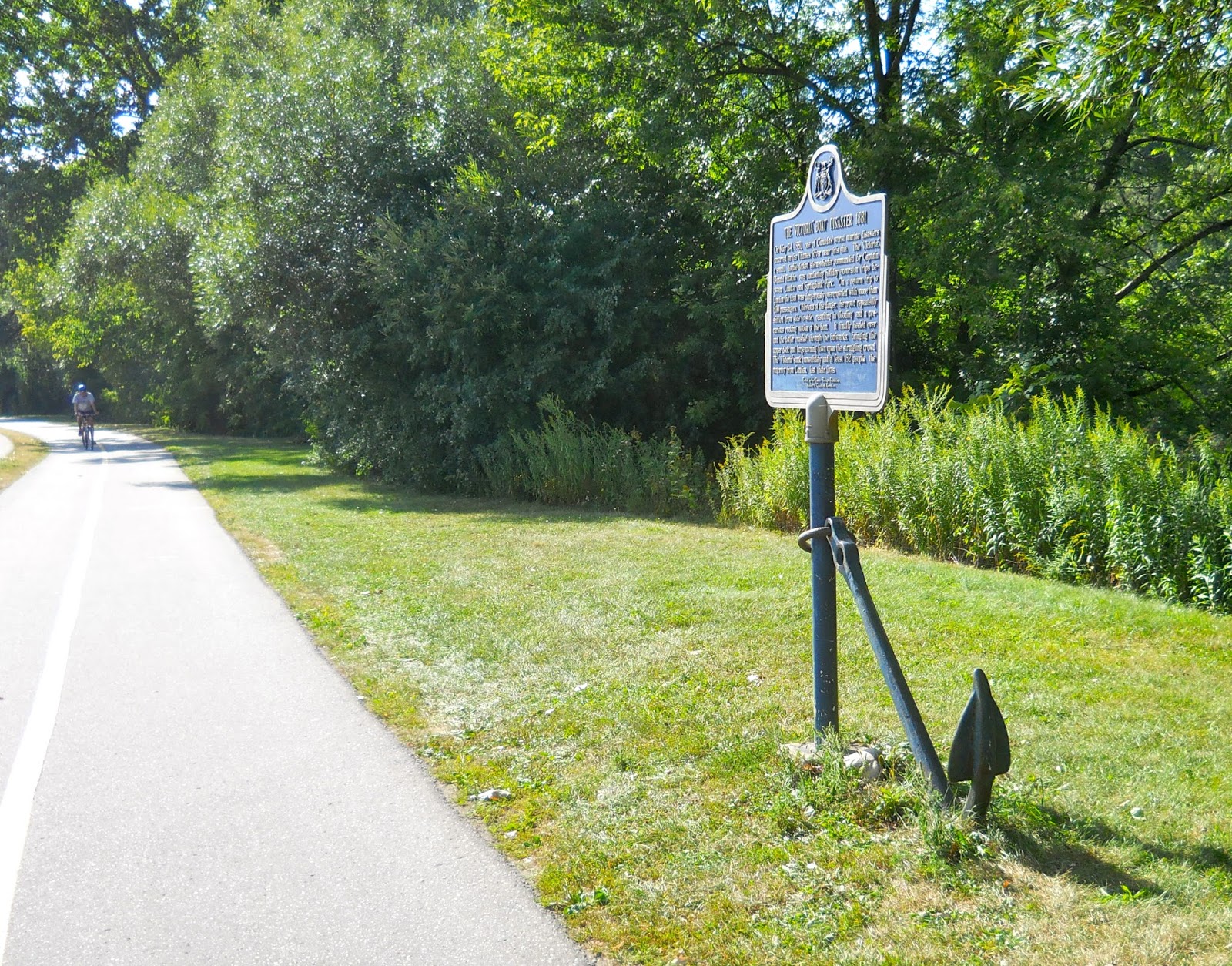
Past the memorial of the 'SS Victoria' boat disaster of 1881.  One of Canada's worst marine disasters;  the small, double-decked, stern-wheeler was on an excursion trip, dangerously overcrowded with more than 600 passengers, and keeled over due to passengers shifting from one side to the other, and sank immediately.  182 people lost their lives.


Continuing slowly to capture memorable pictures.


Under the busy Wonderland Road ....


... towards the Woodland Garden.


Catching glimpses of the river through heavy tree growth.


Passing the Springbank Pumphouse that supplied water to the city between 1878 and 1967
 (When water from the Great Lakes was brought on line).

Continuing westwards towards the children's Storybook Gardens at Springbank Park .... 

Carefully, discuss with the resident Canada Geese how they should protect their young.


... where we wait for the local train on the 'Circle Line'.

Then, finally, the end of the trail appears ahead ....


... inviting us in for a Tim's French Vanilla Latte and Boston Cream donut in Byron Village (Well, don't you just feel like that right now?).


Sunday, 18 August 2013

Management 1 - Entitlement?


I hope that I may use the example in Nancy's previous post, her comment that the enlightened Henry Ford paid his employees above the cost of living to ensure a dedicated workforce.

But, today, the emphasis seems to focus on a worker's entitlement.  It raises many questions, for example, should bonuses be an entitlement?  Are incentives necessary?

This may be my shortest post, as I hope to become part of useful discussion.